
Exhaust Muffler Guide: Balancing Performance and a Quiet Ride

Apart from pollutants and sometimes smoke, cars emit a third environmental factor that can also have a negative effect on people, and that is noise. Since it also comes from the exhaust system, noise is suppressed by a component that’s part of the system — the muffler. Mufflers are essentially silencers that reduce the resonance of exhausts gasses coming from the engine. But by doing this, mufflers also slow down exit, affecting performance. Therefore, aftermarket exhaust mufflers exist to reduce or prevent that within legally permitted limits.
Types of Exhaust Mufflers
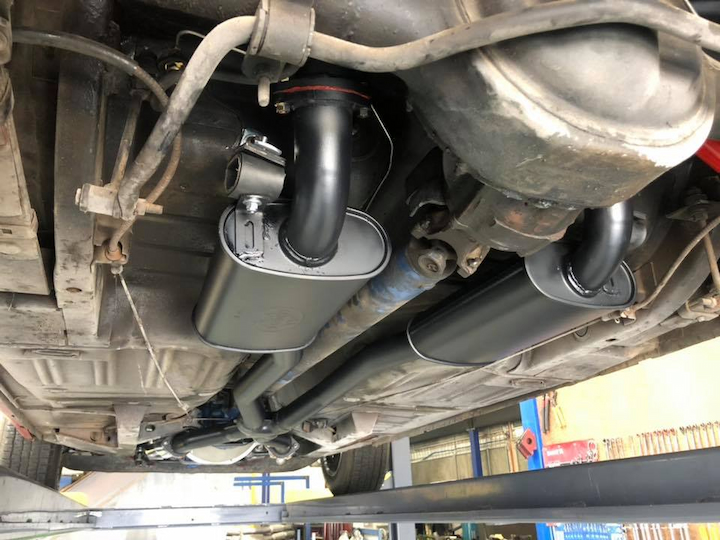
Chambered
Reliant on the method of deflection, chambered mufflers have multiple chambers inside them. When gases pass through them, the chambers reflect their sound waves, making them cancel out each other. The clever design of chambered aftermarket exhaust mufflers makes them a great middle-ground option, as they don’t affect performance as much as a stock muffler.
Straight-Through
If you want something that’s more free-flowing, a straight-through muffler is what you should look for. Why? Well, as its name suggests, it’s made so that exhaust gases pass in a straight line. This helps improve performance and reduce backpressure. While a straight-through muffler has packing material around the straight pipe that runs around it, it’s not as good at keeping noise down.
Resonator
When performance is not an issue for your car, but you want to improve how it sounds in the back, you should consider getting a resonator. This type of muffler is usually found alongside the two to reduce or eliminate sounds such as buzzes, hums, and high-pitched noises. Resonators do this without affecting performance whatsoever. However, because there’s no trade-off, they are quite expensive.
Dual-Exhaust
Upgrading your car’s muffler isn’t always the best choice when it comes to improving performance, as not all outcomes are the same. If you plan on making your vehicle better for towing, you should also upgrade your exhaust system, not just the mufflers. I say mufflers because, in this case, you’ll need two of them, as it’s a dual exhaust system that helps make towing feel more like a walk in the park.
Reverse Flow
Made in the shape of an “S”, a reverse flow muffler’s goal is to make exhaust gases take a different path than they would with a chambered or dual-exhaust muffler. Also known as crossflow mufflers, they make the gases go around bends and curves until they cancel each other out. This significantly reduces engine noise, but it also affects the power and speed of the engine the least out of the above-mentioned mufflers, except for straight-through mufflers.
Tripleflow
Often called a turbo flow muffler, a tripleflow muffler is probably the best at reducing noise coming out of an engine. Their design helps gases travel a greater distance to cancel each other, but that affects performance in a negative way. This is what also makes tripleflow mufflers the most restrictive option. They are also heavier than a chambered muffler, but still better than a stock muffler in both quietness and performance improvement.
Materials of Mufflers
Aluminised
Aluminised steel mufflers are the most affordable option, but also the lightest. While this means they’re easier to install and help with weight savings, they are not suitable in areas where salt and snow are present, as they can start to rust rather easily. Otherwise, they are a fitting option in warm climates.
Stainless Steel
If you live in an area where snow and road salt are present for a good part of the year, stainless steel mufflers are the way to go. They can withstand years of such abuse without any corrosion appearing, even on the surface. However, they are much heavier and pricier than aluminised steel mufflers.
Titanium
With a titanium muffler, you get an even lighter solution than an aluminised steel one, one that just doesn’t rust. Because of this ideal combination of properties, a titanium car exhaust muffler is also the most expensive of the three.
Benefits of an Aftermarket Muffler
Cost
The main reason why you’d want to go for an aftermarket muffler is its price, which is usually much lower than that of an OEM one. This alone makes it a worthwhile investment, as it can save you from a larger expense for something that will still last a long time.
Performance
With an aftermarket car exhaust muffler, you can definitely improve your vehicle’s acceleration and even MPG from what it comes with from the factory. This is especially the case with performance-oriented mufflers instead of ones meant as a replacement.
Fit
Despite being made by a third-party manufacturer, an aftermarket exhaust muffler fits exactly as an OEM part. This means you can find them at most online and brick-and-mortar shops with ease, as they are widely available, unless you have a rare car.
Options
There are plenty of solutions to choose from as far as design and build quality go. This means you can find a muffler for your desires and your pocket, albeit not in equal amounts.