
Flag Etiquette in Australia: How to Respect and Display the Nation

The national flag is a powerful symbol of pride, unity, and identity. From schools and government buildings to international sporting events, this symbol represents the nation’s values and history. Displaying it is more than a patriotic gesture. It’s a mark of respect for the country’s heritage and shared future. However, flying it comes with responsibilities. Observing proper etiquette ensures that the flag is honoured, not just displayed.
Understanding the Australian National Flag

It was first flown in 1901 and formally recognised under the Flags Act 1953. Its design is deeply symbolic, combining elements that reflect the country’s historical ties, geographical location, and federated structure.
In the top left corner is the Union Jack, symbolising Australia’s historical relationship with Britain. Directly beneath it sits the large, seven-pointed Commonwealth Star, one point for each of the six states and one representing the territories. On the right-hand side, the Southern Cross constellation stands out in white, a unique celestial feature visible only in the southern hemisphere. This constellation has guided travellers and seafarers for generations and holds strong cultural resonance for Australians.
Flag Etiquette: Key Rules and Practices
Displaying the Australian national flag with dignity requires adherence to a few key rules. These practices are outlined in official government guidelines and are designed to ensure the flag remains a respected national symbol.
Display and Position
When the flag is flown, it should always occupy the position of prominence. If flown with other national or state flags, it should appear on the far left from an observer’s point of view, or in the centre if three flags are displayed. When on the same flagpole as another flag, the Australian flag must be placed above all others.
It should be raised briskly and lowered ceremoniously. Also, it is traditionally flown from sunrise to sunset; if flown at night, it must be properly illuminated. Care should also be taken to ensure it is not displayed in poor weather, unless it is designed for all-weather use and securely fastened.
Half-Mast Protocol
Flying it at half-mast is a sign of mourning. On such occasions, it is first raised to the top of the mast, held briefly, and then lowered to halfway. It should again be raised to the top before being taken down for the day. This practice is often observed on ANZAC Day, Remembrance Day, and during periods of national mourning.
Condition and Care
The flag should always be in good condition: clean, unfaded, and free of damage. If it is torn or heavily worn, it should be retired and replaced. When storing the flag, it should be neatly folded and kept in a clean, dry space to prevent deterioration.
If a flag becomes too damaged for display, it should be disposed of respectfully. This can involve privately cutting it into small, unrecognisable pieces and discarding it thoughtfully. Burning the flag, though not illegal, is discouraged unless done ceremoniously.
When and Where to Display the Flag
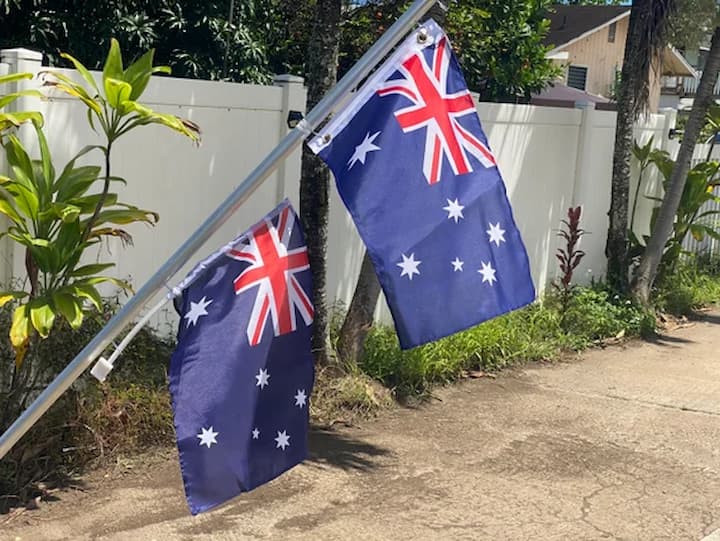
There are numerous occasions when this national symbol is appropriately displayed, both at home and in public spaces. These displays strengthen national identity and encourage collective pride.
National days are particularly significant. On Australia Day (26 January), ANZAC Day (25 April), and National Flag Day (3 September), the flag is commonly flown across the country. Schools, government offices, local councils, and businesses are encouraged to participate.
It is also fitting to display it during international events where Australians are represented, such as the Olympics, Commonwealth Games, or global summits. Many Australians also choose to fly the flag at home, particularly during celebrations, commemorations, or community events. When displayed indoors, it should hang flat against a wall or be mounted correctly on a flagpole with the Union Jack in the upper left corner from the observer’s perspective.
Common Mistakes to Avoid
Despite best intentions, it is easy to get flag etiquette wrong. One of the most common errors is displaying a damaged or faded flag, which undermines the symbolism it represents. Another is allowing it to touch the ground, water, or any object beneath it. This act is considered disrespectful in most protocols worldwide.
Orientation matters, too. The flag should never be flown upside down, except in the event of distress, which is a very rare exception. The Union Jack must always be in the top left corner when viewed from the front.
Improper commercial use is another issue. The flag should not be used in advertising in a way that distorts or disrespects its image, and it should never be used as clothing, bedding, or curtains. While novelty items featuring the flag often appear during major sporting events, proper etiquette calls for a more respectful and thoughtful display.
Conclusion
Ultimately, respecting the Australian national flag is about more than following rules. It is about recognising its role in representing every Australian. This national symbol invites us all to reflect on our shared values, history, and aspirations.
Institutions and individuals alike are encouraged to lead by example. By displaying the flag correctly and understanding its deeper meaning, we help foster a culture of pride and respect that is visible to future generations. In doing so, we honour the spirit of Australia: resilient, diverse, and proudly united.